Foreword
Those who believe the Bible accept it by faith; however, there are many accounts in the Bible that are testable scientifically. One of these accounts is that of Noah having three sons, and these three sons repopulated the entire earth after the flood. This paper provides scientific evidence that all men alive today came from one of three ancient ancestors. Our findings are based on Y-chromosome analysis. The analysis is simple, straightforward, and repeatable; anyone can understand it and repeat it. The data is fully documented herein and generated from mainstream scientific community sources (Reference 1 is the browser and Reference 2 contains the sequences used).
The Bible made the following proclamation thousands of years ago, and now we have the genetic tools to test its validity:
Genesis 9:19 These are the three sons of Noah: and of them was the whole earth overspread.
Genesis 10:32 These are the families of the sons of Noah, after their generations, in their nations: and by these were the nations divided in the earth after the flood.
Background
We know that the Y-chromosome is passed from father to son, and, in general, each generation passes on a few genetic variants to the next generation. These variants provide genetic markers which are highly valuable for tracking ancestry. Geneticists sort people into groups called haplogroups because they contain like genetic markers. The haplogroups form a family tree for all humanity and allow us to trace ancestry back to our most ancient ancestors.
Former Work
We, at Genesis and Genetics, made a preliminary evaluation of Y-chromosome DNA genetic markers and discovered that all human men on earth came from one of three ancient ancestors (Reference 3). We found that any human man could trace his genetic markers back to one and only one of three ancient ancestors. Any man with a marker ‘A’ at rs9786139 is from one ancient ancestor, a marker ‘A’ at rs17306671 is from another ancient ancestor, and a marker ‘G’ at rs3900 is from the third ancient ancestor. It was easy to associate these three most ancient ancestors with Ham, Shem, and Japheth by looking at Biblical history of migration and nations. Ham had the ‘A’ at rs9786139, Shem had the ‘A’ at rs17306671, and Japheth had the ‘G’ at rs3900.
This former research was based on a study of 57 modern human men. All the men had one, and only one of the three markers stated above.
Note: We use the terms “mutations,” “variants,” and “markers” interchangeably.
Confirmation
Since our original study, we have looked at many more sequences, a total of 1233 Y-chromosome genomes, and found they all conformed to our original findings. Reference 4 documents the 1233 human genomes and which ones are from each of Noah’s three sons. All 1233 humans had one and only one of the three markers. There were no exceptions. This paper confirms our original findings and compares our Biblical ancestral family tree to that of mainline science.
Comparison to Mainline Science
In general, our analysis agreed with mainstream science concerning haplogroups. Therefore, our family tree uses the same haplogroups as our friends in mainstream science. But they are rooted differently. Here is the secular science tree followed by our family tree. There are several versions of the secular trees (called phylogenetic trees), but we, generally, used the one generated by the International Society of Genetic Genealogy, ISOGG (Reference 5).
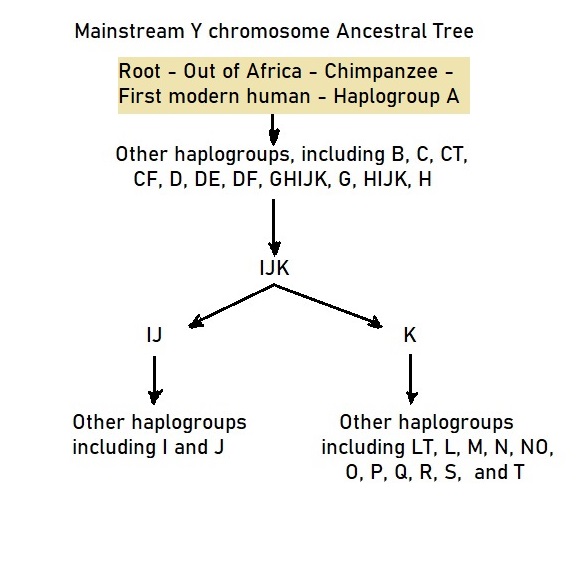
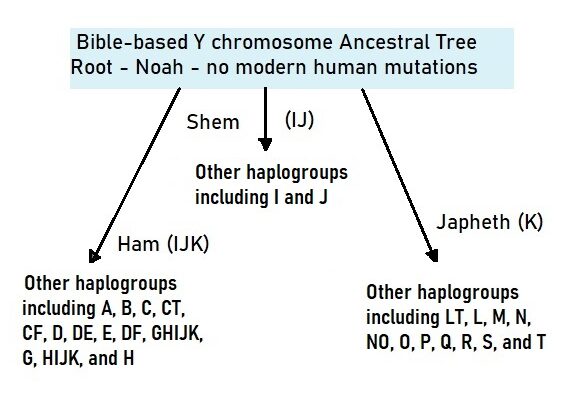
As one can see, the two trees are similar, but the root and flow of genetic markers are different. The secular tree is rooted in haplogroup A, and the Biblical tree is rooted in Noah dividing into three separate haplogroups; one from Ham; one from Shem; and one from Japheth. We do not present Noah’s DNA, but it is simply his three sons’ DNA less their genetic markers.
Finding the Tree Root
Armed with these 1233 diverse genomes, we began our search by noticing that a few mutations/genetic markers, were common in the population; some were up to 52 percent of the population. It is quite logical to assume that the higher the mutation’s frequency, the better chance that it is at or near the root of our family tree.
For example, if a mutation is in 1/2 of the population, it probably originated when the population was approximately 2 men. If a mutation is in 1/10th of the male population, it probably originated when the male population was approximately 10. And if a mutation is in1/1,000,000), it probably originated when the world population was 1,000,000.
So, we decided that any mutation with a frequency of more than 5 percent could be one of Noah’s three sons. This assumption would allow for some genetic drift and the inability for our 1233 subjects to exactly match the whole world population distribution.
All Men came from three ancient ancestors
Next, we took each of the mutations with frequencies higher than 5 percent and used them to form genetic groups, i.e., haplogroups. Quickly, we realized that every mutation belonged to one and only one of three ancient ancestors.
It appeared that we found Shem, Ham, and Japheth. There was a Shem haplogroup, a Ham haplogroup, and a Japheth haplogroup. All 1233 genomes fit into one and only one of the three. There were no exceptions. The three root mutations had frequencies of 10%, 38%, and 52%. And, as expected, they added up to 100% of the population. Furthermore, Shem, Ham, and Japheth were associated with the three ancient ancestor mutations easily by looking at the geographical locations of each group and comparing them to Bible history. Ham went south and east; Japheth went north and east, and Shem populated the Near East and Europe.
Noah’s Y-chromosome is impossible to find directly. The reason is that he is the origin of all male humanity and he had, by definition, no genetic markers. Therefore, the way to find Noah’s Y-genome is by determining the genomes of his sons and deleting all their mutations.
The true root of humanity was Adam. Adam’s DNA went through the bottleneck of Noah. So we all came from Adam, and we all came from Noah. Adam is the root of all humanity, and Noah is the root of post-flood humanity.
Genetic Mutations/Markers Flow in One Direction
Just as water flows downstream, so do genetic markers. Genetic markers flow from most ancient ancestors to modern ancestors. For instance, your great-grandfather passed markers to your grandfather who passed additional markers to your father. Your father passed his additional markers to you. And if you are a man, you too will pass new markers to your sons. Lineage flows downstream. More and more new markers appear in offspring as the generations pass. However, the original markers of your ancestors remain in your genome. A key point here is that as the markers flow away from the root, the new markers divide the offspring into sub-haplogroups. This dividing into sub-haplogroups shows the direction of the genetic marker flow. Distant branches have only the markers close to the root but are missing many of the markers in their cousins, second cousins, etc.
Therefore, as expected, the data shows that markers flow from Noah’s three sons to their sub-haplogroups. Consider just haplogroup K. Everyone from haplogroup K has the rs3900 G marker. Likewise, the sub-haplogroups have additional markers that show they are later generations forming smaller haplogroups such as M, N, O, P, Q, R, S, and T. T must come from K, but K cannot come from T.
Since genetic mutations/markers flow downstream, it is not possible that the root of the Y-chromosome family tree is rooted in a marker with a small frequency. In order for that to happen, it would take many bottlenecks, overwrites, drift, and other genetic contortions.
Full Population Representation
The three adjacent haplogroups, IJ, IJK, and K contain 100 percent (Ham 38%, Shem 10%, and Japheth 52%) of the 1233 genomes analyzed. In other words, they are the source of all modern humans. Take any other combination of the other haplogroups and mix and match them; they do not represent all humanity; they do not add up to 100 percent. The only way you get one hundred percent is to use IJ, IJK, and K.
Biblical and Secular History
The haplogroups IJ, IJK, and K comprise people from Mid-East, West Asia, and Near East. According to the Biblical narrative, all humanity came from the Armenian mountains which are in West Asia and close to the Near East and the Mid-East. In short, these haplogroups locations fit nicely into Biblical history.
The historical age began in Mesopotamia, shortly after the flood. These earliest writings document a worldwide flood and the world populated by flood survivors. Nowhere do these legends and writings record mankind originating from other parts of the world.
Summary
The Y-chromosome DNA is the perfect vehicle for scientifically testing the portion of the Bible that says all modern human men were born of three ancient men. The Y-chromosome data of 1233 genomes corroborates the Biblical account. We now have a Biblical family tree and can trace our ancestry to the Biblical sons of Noah.
Future Work
We are in the process of identifying the DNA of Noah’s 16 grandsons in the family tree.
References:
- http://useast.ensembl.org/info/about/publications.html
- https://www.genome.gov/27528684/1000-genomes-project
- https://www.genesisandgenetics.org/2021/04/16/y-chromosome-migration-and-the-biblical-phylogenetic-tree-or-finding-ham-shem-and-japheth-via-y-chromosome/
- https://www.genesisandgenetics.org/Ancient.xlsx
- https://docs.google.com/spreadsheets/d/1Y0GXjhazYa46u0EpPA9b0Y0RVWuh5lDzww_o979mbjQ/edit#gid=1904113265
- https://useast.ensembl.org/index.html

It is very interesting to focus on these three specific mutations that don’t seem to cross among the three groups, but there is one thing I am not understanding. The entire premise is that tracking these mutations on the Y chromosome allows for one to determine the male parental line. But how is there continuity from Noah to his sons?
Are you suggesting that Noah had A on rs17.. and G on rs39.. and A on rs97.. (i.e., all three of the markers on the respective SNPs), but that each of his three sons only carried one of those three markers, and neither son carried the same marker? Or are you saying that Noah likely had none of these markers, and the three unique mutations happened to each respectively in the same generation?
That would seem to be quite a leap and presumption that this all happened in one generation. Why doesn’t this data more likely imply that there are three main original human groups from which all humans came (i.e., if you were taking the data objectively without first trying to fit into the presumption that everyone on earth came from Noah based on how you are interpreting the flood to be worldwide rather than local)?
Secondly, when looking at the rs3900 SNP data today (12/13/2022), its MAF is listed as 48% (not 52%), meaning that the numbers don’t add up to 100% as stated in some of this earlier research on this site. These three markers’ MAFs only add up to 96% as of today.
You have asked some excellent questions that will be the subject of upcoming blogs. I will do my best to answer your questions briefly with our findings so far:
(1) Continuity between Noah, IJK, IJ, and K. Look at https://docs.google.com/spreadsheets/d/1fyWMHOYKcR-t77kV-cN79A6B5-aBpQS8Y7W5juVKLV8/edit#gid=1904113265, and you will see that K is defined by M9, IJK is defined by L15 and possibly 5 other mutations, and IJ is defined by M249 and possibly 43 other mutations. The “possibly xxx other” refers to “Next=generation sequencing. I’m not sure that these next-generation sequencing mutations are all defining. Nonetheless, if you delete the defining mutations, you have Noah. It is important to remember that Noah’s sons lived hundreds of years, so we are not sure how many mutations they would have accumulated.
(2) We are assuming that Noah carried none of the markers. According to the scriptures, all three sons were born close to one another, possibly in the same year. The markers would have been developed by the three sons in the presumed 100 years before the flood and also in the years following the flood.
(3) Yes, if you prefer the evolutionary model, it would work with the origin of the three groups, but they were very closely related and didn’t come from Africa.
(4) Yes, rs3900 is listed with an MAF of .48, but MAF means Minor Allele Frequency. One may flip them easily to make them Major Allele Frequency, particularly when they are close to 50 percent. If you look at our Excel spreadsheet, it is evident that rs3900 belongs with IJK.
You asked very good questions. We are still working on it and have found some very interesting information concerning Noah’s grandsons. We should publish something in 6 months or so. I have severe congestive heart failure, and it has slowed us down.
Thanks you for your response. I look forward to your upcoming blog entries. I’m sorry to hear of your heart issues, and you have my prayers.
To clarify, I don’t “prefer” any evolutionary model, and I don’t think the “out of Africa” model makes sense and is a speculative position based on Darwinian assumptions which I don’t accept. But having said that, I don’t know what I think about whether all humans have necessarily come from Adam and then Noah at the bottleneck or whether there is a different explanation. I used to believe strongly that all descended from Adam, but I see problems today with reconciling Genesis 1 with Genesis 2 which might imply that our Evangelical assumptions of no humans other than Adam and his line might be faulty. I am open to arguments on both sides. I just want to try to look at genetic data objectively and not with preconceived bias towards one or the other position (which is hard for us humans to do). The data could point to the three sons of Noah, or it could point to three different human groups created by Elohim/YWHW, each with a calling and purpose but possibly without a common human ancestor (and in no case arising from Darwininan gradualistic evolution). If you could address this particular debate as to two competing theories in your blog entries, that would be timely and challenging.
Sorry for the typos above. It’s hard to proofread in a little box.
In general, I don’t want our blogs to be argumentative. We aim to defend the Biblical narrative, not tear down others’ ideas.
Concerning Genesis one and two, here is our take on them:
https://www.genesisandgenetics.org/2012/02/17/62/
May God richly bless you in our pursuit of truth,
James
Your seem to be very confused as to how Y DNA works. IJK is the ancestor of IJ and K. You said, “…you will see that K is defined by M9, IJK is defined by L15 and possibly 5 other mutations, and IJ is defined by M249..” That is true. What you apparently don’t realize is that I, J, and K all have the L15 mutation. Why is that? It is because they all have the same forefather. It is not that dissimilar to DE haplogroup and the YAP mutation. The DE haplogroup is the only haplogroup with the YAP mutation. It is “defined” by it, but both D and E that have mutations that distinguish themselves from each other as separate haplogroups both have the YAP mutation. Your haplogroup basis that the sons of Noah descend from only either IJK, IJ, or K is genetically impossible.
You seem to be very confused as to how Y DNA works. IJK is the ancestor of IJ and K. You said, “…you will see that K is defined by M9, IJK is defined by L15 and possibly 5 other mutations, and IJ is defined by M249..” That is true. What you apparently don’t realize is that I, J, and K all have the L15 mutation. Why is that? It is because they all have the same forefather. It is not that dissimilar to DE haplogroup and the YAP mutation. The DE haplogroup is the only haplogroup with the YAP mutation. It is “defined” by it, but both D and E that have mutations that distinguish themselves from each other as separate haplogroups both have the YAP mutation. Your haplogroup basis that the sons of Noah descend from only either IJK, IJ, or K is genetically impossible.
You have misread the post. IJK, going backwards is HAM. The evolutionists say IJK is the head of Japheth and Shem. We say that IJK is the head of HAM, reading backwards. Please re-read the post. The first tree is what evolutionists think but we have Noah as the head. HAM has L15 A,M522 G,M523 A and M578 C. These are Ham’s line.
We are pleased that you are thinking about these things. Keep up the good work. We will all get to the truth by seeking.
Admin
Again, that is the problem. Y DNA haplogroups IJ, I, J, and K all have the L15 mutation. They all have the same forefather. For example, you have IJK as Ham but also have haplogroups such as DE as being descended from from IJK, but DE doesn’t have L15. It isn’t possible.
B
You have misread the post. IJK, going backwards is HAM. The evolutionists say IJK is the head of Japheth and Shem. We say that IJK is the head of HAM, reading backwards. Please re-read the post. The first tree is what evolutionists think but we have Noah as the head. HAM has L15 A,M522 G,M523 A and M578 C. These are Ham’s line.
We are pleased that you are thinking about these things. Keep up the good work. We will all get to the truth by seeking.
Admin
Oh, I see what you are trying to do with L15 adenine and guanine. It’s still erroneous by the way. Even if you look at that excel screenshot you see that almost everyone on the screenshot has L15 guanine to include Vietnam and Japan. Vietnam and Japan are mostly haplogroup O, which you accurately have as being descended from Japheth. Your process with the “mean allele frequency” being the root of the sons of Noah doesn’t work for a variety of reason. To start, it seems as though you have fallen for the trap/lie that most people that believe in the Bible to some degree believe about the land promised to each son of Noah. That lie being that Shem received the Middle East, Japheth received Europe/Asia, and Ham received Africa. You then seem to build your model on finding Y DNA most common in the modern regions assuming that the current inhabitants of various regions are similar to the indigenous. That doesn’t work. Ham was not promised Africa. He was promised the southern part of the Earth. Shem was not promised the Middle East. He was promised the middle of the Earth. Japheth was promised the North. Long story short territory promised to Shem includes a large part of Africa aka Afra (lookup Afra in Latin, see Jubilees 8 and verse 15 specifically). And many of his descendants live in Africa (haplogroup DE). Not to mention the numerous verses in the Bible that explicitly state that Israelites specifically would be scattered in Africa and later abducted by ship from Africa into slavery. Looking at the Y DNA of Africa and assuming that everyone there is a Hamite would be erroneous. Just like looking at Y DNA of modern inhabitants of America, Israel, Iraq, etc. and assuming that it accurately represents indigenous populations would be erroneous. Also, why do you assume that roughly 1/3 of the male population of the earth came from each son of Noah? Nothing even suggests that. The predicted vs observation thing you have going based on the number of sons is incorrect. Ham is not numerous. He is only AB. Most of the world is Japheth. There almost 90% of the world. Start with Biblical prophecies pertaining to Israel and where they would be scattered and find the Y DNA of Israel ( E1b1a) other nations will be revealed from there. Any other method fails miserably.
Look at the 1001 genomes for y-chromosomes and you will see that many Africans have the L15 A and the L15 G is prominent in other lands. It is clear. Yes, some far east and southern nations also have L15 A. But it must be realized that Shem, Ham, and Japheth interbred with many, given us what we have now. You talk about mutations, but do you admit that much of Africa has the L15 A? Remember, you are getting your information from the evolutionary mutations, they are going the wrong way.
in the 1001 genomes, 38 percent of there data base has L15 A. Plot a map and see where the L15 A is. You may call the L15 G a mutation, but I don’t. It is a simple variance of opinions.
We are pleased that you are looking a Y-chromosomes. Keep up the good work? You may be right!
Admin
“African” does not equal Ham. The land God promised to Shem includes a large part of Africa. There are numerous descendants of Shem (E haplogroup mostly) that live in Africa. You can not look at the DNA of people of various regions in and of itself and conclude that the DNA belong to a particular son of Noah because supposedly that area belongs to a particular son of Noah. People migrate and people conquer other territories. You allege that DE is from Ham. Explain how haplogroup D has a minimal presence in any part of Africa. Haplogroup IJ being from Shem is prophetically impossible. Nothing about them matches Shem and definitely not Israel. Israel was prophesied to be scattered in Africa and be taken away by ship into slavery. It doesn’t apply to people in IJ. The people falsely claiming to be Jews were almost exclusively in Europe.
We appreciate your opinion and respect it.
Thank you
Admin
Let me know if I understand correctly or not. This analysis suggests a different Y chromosome haplotree than the typical diagrams such as found here: https://tickle.one-name.net/understanding-y-dna-2/. Do you have an article or blog that breaks down collections of the studied genomes into either haplogroups or ethnicities associated with the proto-Ham/Shem/Japheth markers? I.e. a list of “Ham” groups, “Shem” groups, “Japheth groups? Presumably some established ethnicities could have formed from the merging of people groups of two or all three at some point down the line from the original migrations.
The site you gave me is one that believes in the “out of Africa” theory. We reject that theory and submit the tree in our blog, which is the “out of Noah” theory. We use the same haplogroups, but root them differently as shown in our blog https://www.genesisandgenetics.org/2022/12/12/y-chromosome-validates-bible/
If we can help you further, let us know
James
I join you in rejecting the out of Africa (OOA) theory. You linked the article I was commenting on so that link doesn’t help with clarification. I think the work you’ve done is probably very useful in identifying the migration of different ethnicities but the haplogroup identifiers are kind of connected (by there letter combos) to the OOA theory. Has your work on this included any maps or ethnicity connections to the Ham/Shem/Japheth markers. I.e. something like Celts have the Japheth marker, Spaniards have the Shem Marker, etc.
Steve,
We have generating maps in our job jar. It should be quite easy, but our job jar is very full.
Admin
Why do my comments keep getting removed?
They don’t. I have severe heart failure and don’t get to them everyday.
Admin
You say Neanderthals are antediluvian man, yet their Y-chromosomes are comparable to Haplogroup A. How do you explain this?
Joseph,
I don’t think neanderthal Y-chromosome data is anywhere close to haplogroup A. Please give me your analysis of Haplogroup A and Neanderthal. We have very little Neanderthal Y-chromosome data, and if you have some new sequences I would like to know. We will look at them.
Admin
Good morning/afternoon, here you go:
https://answersresearchjournal.org/neanderthal/ancient-dna/
(Note that they switch the identification of Shem and Japheth so Japheth is IJ and Shem is K but the basic structure is the same as yours.)
Also, thank God that you are not dead—heard elsewhere you were undergoing heart failure.
Also, have you made identifications for the 16 grandsons yet? Or is that still a work-in-progress?
I would like to get back to the grandsons, but am working on another project. We have found why the Holy Spirit was over the water on day one. We are writing a book about that.
Concerning the grandsons, we have found that the big key is Canaan, he only had two sons and his DNA stopped there. That is why the sons linage of Ham didn’t make sense with respect to the other lineages. All the “its” came from Canaan’s daughters who married those from Shem and Japheth. If you decide to take this task on, please do. I have so much I want to do and my health is bad. I will pray for you.
Admin
I’m not sure if Canaan only had two sons. Yes, two are singled out in Gen. 10:15, but it appears that the tribes listed in 10:16—19 (which are singular in Hebrew, i.e. the “Jebusite”, “Amorite”, etc.) appear to have been derived from eponymous ancestors, which are likely Canaan’s sons themselves. What do you mean by “the sons linage of Ham didn’t make sense with respect to the other lineages”?
Also, there are mitochondrial DNA (mtDNA) macrohaplogroups for the maternal lines to consider. I have seen mtDNA L and M for Ham’s wife, mtDNA N for Shem’s wife, and mtDNA R for Japheth’s wife.
I still agree with you though that Neanderthals and Denisovans are most likely antediluvians, but this does not explain their YDNA’s similarity to Hg A.
I also use the timeline here:
http://xenohistorian.faithweb.com/genesis/chronology.html
Joseph,
I had to stop looking for Noah’s grandchildren, since I had too many other projects. However, here is what I know. Looking at Genesis 10 we have:
Gen 10:15 And Canaan begat Sidon his firstborn, and Heth,
Gen 10:16 And the Jebusite, and the Amorite, and the Girgasite,
Gen 10:17 And the Hivite, and the Arkite, and the Sinite,
Gen 10:18 And the Arvadite, and the Zemarite, and the Hamathite: and afterward were the families of the Canaanites spread abroad.
Gen 10:19 And the border of the Canaanites was from Sidon, as thou comest to Gerar, unto Gaza; as thou goest, unto Sodom, and Gomorrah, and Admah, and Zeboim, even unto Lasha.
Gen 10:20 These are the sons of Ham, after their families, after their tongues, in their countries, and in their nations.
Notice that this is different than any other lineage. He gives the two sons, but not their sons. The other lineages gave the son’s names. But, instead, he gives the “its” names like: “the Jebusite, and the Amorite, and the Girgasite.” There was no Hamitic father. So, in my opinion Canaan had two sons, but no grandsons, Canaan had daughters. These daughters were married to the boys of Shem and Japheth. This is just my opinion.
Once you understand Genesis 10, it will fit into the Y-chromosome tree. I found it fit for each of the Shem, Ham, and Japheth. Here is one tree I used
https://docs.google.com/spreadsheets/d/1fyWMHOYKcR-t77kV-cN79A6B5-aBpQS8Y7W5juVKLV8/edit?pli=1&gid=1904113265#gid=1904113265
I’m Sorry, I misread your email. Concerning mitochondrial DNA, yes, you are correct. If you take any full modern human mitochondrial DNA, and use place it on a phylogenetic tree, Neanderthal will go to A. That is correct. However, remember that there are some 200 mutations between any modern human and Neanderthal. So, it had to come out to some haplogroup. I am sure that with a little time, you could figure it out. Let me know if you do. The difference, in my opinion, is that between Neanderthal and Modern humans there are some 200 mutations. These mutations aided the life span to go from 900 to 400 years, they to 70 years.
We have done extensive work on mitochondria and think we have Eves DNA and how many daughters she had. We should publish is, but it takes too much time. I am 80 and with a bad heart, I must do what is most important.
Thank you for your interest in the things of God,
Admin, I haven’t checked this message and could have made mistakes.
So far, this is what I have for the grandsons. This is definitely not definitive, and I might change my mind in the future.
I have decided to use the Answers in Genesis model. It has the same tripartite division as yours, but switches up Shem and Japheth’s identities (Shem = K, Japheth = IJ). This is because I appears (based on ancient DNA samples) to have been the original European haplogroup, with J perhaps being initially Indo-Aryan. Haplogroup R came later from Asia and the Middle East. Hg J may have been pushed out into the Middle East in the process and intermingled with Semites (Gen. 9:27).
For Japheth’s sons, I think Gomer (northern and western Europe) is I1 and Tiras (Thrace and Sardinia) is I2. Magog could either be I or J. Madai is J1, and the rest are J2.
For Ham’s sons, on the branch from IJK back to A, there are four major sub-branches—F, C, DE, and BT.
I think F, which produced G and H, is Phut. Phut is associated with both Northern Africa (Gen. 10:6; G) and India (Ezekiel 38:5; H). C would be Canaan. Arthur Custance has him as the progenitor of East Asians and Native Americans, who carry C. DE which produces D and E would be Mizraim (Egypt and North Africa). This leaves BT which produces A and B as Cush (Ethiopia and sub-Saharan Africa).
For Shem’s sons, I think Elam, Lud, and Aram belong to L. Joktan could have the T. Ashur could be L or T. Hence Peleg is K2. R, which is widespread, numerous, and originated near the Middle East, is the best candidate for Abraham (Gen. 22:17-18).
If R is Abraham then R2 would be Ishmael and Abraham’s other 6 sons who lived in the east (Gen. 25:6). R1 would be Isaac with Esau/Edom’s lineage virtually wiped out, and both R1a (tied to the modern Jews who consider themselves to be Levites) and R1b would be from Jacob.
Alternatively, it is also possible that Abraham could have had K2 like his forefather Peleg as well, with Ishmael as N, his other 6 sons in the east as O, Isaac and Esau as P, and Jacob as Q and R. For me, Abraham must have been the father of at least one haplogroup due to him being the father of many nations. If Shem is IJ and Japheth is K, then Abraham would not be a haplogroup founder, and I am not comfortable with that.
Note that the only people blessed in the Bible to have numerous descendants are Japheth (IJ), Abraham (R or K2), Jacob (R1 or QR), and Joseph (R1b).
God Bless and kind regards and get well soon : )
(reposted to allow for replies)
So far, this is what I have for the grandsons. This is definitely not definitive, and I might change my mind in the future.
I have decided to use the Answers in Genesis model. It has the same tripartite division as yours, but switches up Shem and Japheth’s identities (Shem = K, Japheth = IJ). This is because I appears (based on ancient DNA samples) to have been the original European haplogroup, with J perhaps being initially Indo-Aryan. Haplogroup R came later from Asia and the Middle East. Hg J may have been pushed out into the Middle East in the process and intermingled with Semites (Gen. 9:27).
For Japheth’s sons, I think Gomer (northern and western Europe) is I1 and Tiras (Thrace and Sardinia) is I2. Magog could either be I or J. Madai is J1, and the rest are J2.
For Ham’s sons, on the branch from IJK back to A, there are four major sub-branches—F, C, DE, and BT.
I think F, which produced G and H, is Phut. Phut is associated with both Northern Africa (Gen. 10:6; G) and India (Ezekiel 38:5; H). C would be Canaan. Arthur Custance has him as the progenitor of East Asians and Native Americans, who carry C. DE which produces D and E would be Mizraim (Egypt and North Africa). This leaves BT which produces A and B as Cush (Ethiopia and sub-Saharan Africa).
For Shem’s sons, I think Elam, Lud, and Aram belong to L. Joktan could have the T. Ashur could be L or T. Hence Peleg is K2. R, which is widespread, numerous, and originated near the Middle East, is the best candidate for Abraham (Gen. 22:17-18).
If R is Abraham then R2 would be Ishmael and Abraham’s other 6 sons who lived in the east (Gen. 25:6). R1 would be Isaac with Esau/Edom’s lineage virtually wiped out, and both R1a (tied to the modern Jews who consider themselves to be Levites) and R1b would be from Jacob.
Alternatively, it is also possible that Abraham could have had K2 like his forefather Peleg as well, with Ishmael as N, his other 6 sons in the east as O, Isaac and Esau as P, and Jacob as Q and R. For me, Abraham must have been the father of at least one haplogroup due to him being the father of many nations. If Shem is IJ and Japheth is K, then Abraham would not be a haplogroup founder, and I am not comfortable with that.
Note that the only people blessed in the Bible to have numerous descendants are Japheth (IJ), Abraham (R or K2), Jacob (R1 or QR), and Joseph (R1b).
God Bless and kind regards and get well soon : )